


Keeping accurate notes during complex tarot spreads can feel like trying to capture a passing cloud. Cards carry layers of meaning. Patterns emerge and disappear in a blink. Querents share sensitive stories, and intuition moves fast. In our experience at MysticLog, getting your reading down—truly down—while everything is fresh makes the difference between a vague memory and a profound record. Over the years, we’ve found strategies and systems to help Tarot readers, both new and seasoned, document everything with clarity. Let’s move through a journey of practical approaches, personal insights, and useful tools designed to help you never lose another rich detail in your work with the cards.
Why good note-taking matters in complex tarot spreads
Many Tarot spreads, such as the Celtic Cross or the Zodiac Wheel, are challenging to record because there’s just so much happening at once. Each card connects with others, positions shift meanings, and patterns only become clear later. When you read for someone (or for yourself), every detail can change the overall story that emerges.
Accurate notes keep the magic alive long after the reading ends.
We believe the real value in taking great notes is threefold:
- Reflection: Revisiting readings reveals hidden layers and evolving patterns.
- Professionalism: Detailed records help you follow up with querents, remember their stories, and build trust over time.
- Growth: Notes expose strengths, highlight learning edges, and show how your interpretations develop with experience.
Every card, remark, and intuitive surge forms a mosaic. When you capture these in detail, your practice gains depth and structure—making you not just a better card reader, but a more confident guide.
How to prepare for accurate notetaking before a reading
We’ve found that accurate note-taking always starts before the first card hits the table. Preparation is the soil where clear documentation grows.
Declutter your space and mind
A clean workspace—a calm mind. Clear away physical clutter and take a few deep breaths before starting. Less distraction means more presence, which translates directly into better memory and sharper notes.
Gather your tools
Have your preferred tools ready. Some readers love notebooks. Others work with digital devices. We often hear readers using MysticLog enjoy both worlds: pen-and-paper for sketches, with speedy cloud backup for searchable, long-term archives.
- Notebook or journal
- Pens and colored markers (for multi-layered spreads)
- Laptop, tablet, or phone if you use apps like MysticLog for recording (either during or after the reading)
- A template or printout for large spreads, so card positions are clearly labeled
Have a note-taking structure in mind
Approaching a reading with a structure helps ensure nothing gets lost. Will you:
- Record card-by-card insights?
- Note questions before pulling cards—or only after you have the spread?
- Summarize the overall pattern at the end?
If you confess to feeling “all over the place” when taking notes during big spreads, you’re not alone. Many professionals do. That’s why a consistent pre-reading ritual is a gift to your future self, and to your querents.
Pillars of effective tarot note-taking
Let’s look closer at the habits and formats that keep notes accurate even in the busiest readings.
Start with the context
Don’t just jump into card meanings. Begin every entry with core information:
- Date and time
- Name (or code) of the querent
- Question or intention
- Spread chosen
This is the baseline. Like an address on a letter, it tells you where the reading belongs.
Describe the spread layout
Draw a quick sketch, take a photo, or use a digital template to capture which cards are in which position.
This is especially helpful for large or non-linear spreads. If working digitally, MysticLog includes custom templates for marking spreads—saving time and reducing confusion. But even with pen-and-paper, a little box or circle with a card’s name can jumpstart your memory months later.
Record card interpretations in sequence
List each position, card pulled, and your interpretation. If you’re short on time during a reading, use quick shorthand—then expand once you have space to reflect. Example:
“Pos 5 (Past): 3 of Swords (heartbreak, old wounds still heal, tied to last year’s breakup—note sadness in querent’s posture).”
If cards form a clear connection (for example, two sword cards landing in sequence), make a note, such as “Repeat of sword energy—mental strain across relationships and work?”
Capture intuitive hits and querent reactions
Tarot is as much about intuition as formal meanings. Whenever something stands out—a phrase that pops into your head, a symbol that causes a reaction, a shift in the querent’s body language—write it down. Sometimes, these are the keys to breakthrough insights on later review.
We recommend adding a “Noted Intuitions” section for each spread’s notes.
Jot down action steps and closing summaries
End every spread’s entry with:
- Main takeaways in two or three bullet points
- Suggested action steps or focus for the querent
- Any thoughts or feelings you want to revisit in future sessions
This not only strengthens your closure, but also helps you track your own growth and follow-up ideas effectively.
 Tips for staying detailed during fast-paced readings
When you’re in the moment, it can feel impossible to keep up with the amount of information pouring in. Yet, you want your notes to capture not just the facts, but the energy of the reading. Here’s what we’ve learned works best:
Use shorthand for speed
Create symbols or abbreviations for common concepts. For example:
- “R” = Reversed
- “PS” = Possible Solution
- “!Int” = Intuitive hit
- Quick icons, like a heart for relationship or a star for highlight
Over time, these codes will feel natural, and they keep you moving through complex spreads without pausing to search for words.
Audio record with consent
Sometimes, a reading moves too quickly to write. In those sessions, we suggest recording audio—always with the querent’s clear permission. After the session, transcribe key moments, or use a digital tool to add audio notes right inside your client profile.
Use digital tools (when possible)
Digital apps like MysticLog simplify capturing, organizing, and searching notes. Features like automatic spread layouts, symbol libraries, and AI-generated prompts can cut your time in half. And searchable archives mean you never lose track of a detail, even months later.
For a fuller discussion of how to move from scattered notebooks to an organized digital archive, we recommend the article on organizing client records in mystical consultations.
Review and elaborate immediately after the session
Once the cards are back in the deck and the room is quiet, spend a few minutes filling in any blanks while the memory is fresh. Those first five minutes post-reading are golden for catching loose threads and noting subtle links you may have missed.
Your best insights arrive when the cards are still warm.
If you use MysticLog, this is the perfect moment to upload or type in your rough notes before you forget the small yet key details.
How to annotate for clarity and depth
Complex tarot spreads are rich in patterns and surprises. To make the most of your notes, annotate them with comments, highlights, and reflection. Here’s how:
Highlight themes or repeated cards
When a card, suit, or number repeats, make it stand out. Use colored pens in your notebook (blue for swords, red for cups, etc.), highlight with digital tags, or add entries to a “Themes” field. This makes trend tracking simple across multiple readings.
Layer your interpretations
For spreads of more than five cards, it helps to write in layers:
- First, the “book meaning.” What does this card traditionally mean in this position?
- Second, the personalized meaning. What is unique for this querent and their story?
- Third, the connection. How does this card relate to others in the spread?
This layered approach, especially useful in digital platforms like MysticLog, ensures your notes read like a conversation with yourself, growing deeper on each review.
Use visual aids
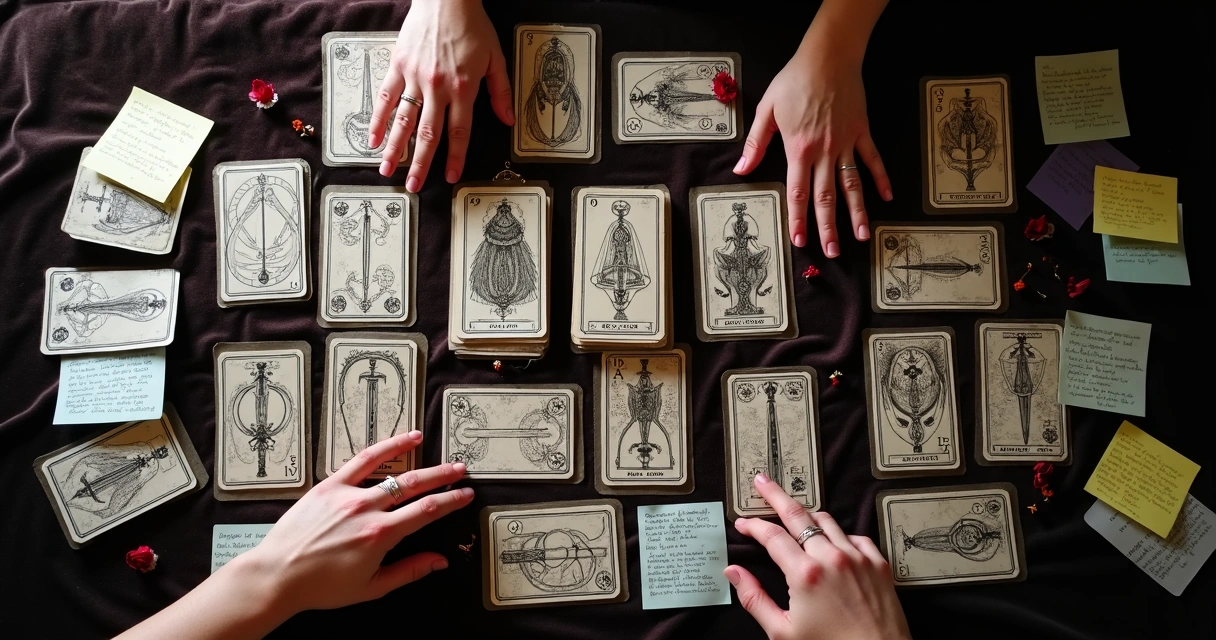
Draw arrows, circles, or diagrams to show how cards interact. Many readers snap photos of the spread and mark it up with annotations post-reading. This turns your notes into a learning resource and a record to show returning querents, reinforcing your insight and care.
 How to organize notes for long-term retrieval and learning
Accurate notes only serve you if they’re easy to find and reflect upon later. This is where a good system shines.
Label and categorize every entry
Include tags for:
- Querent’s name or code
- Date
- Spread type (Celtic Cross, Horseshoe, Relationship, etc.)
- Themes (career, love, health, etc.)
- Unusual occurrences (i.e., “all court cards,” “many reversals”)
This makes searching and trend-spotting a pleasure, not a chore. MysticLog includes customizable labels for all note entries, but you can apply similar tabs or color coding in analog systems, too.
Review and reflect regularly
We recommend setting aside a time each week or month to read through past notes. Look for:
- Recurring cards, numbers, or archetypes
- Your own evolving interpretations
- Feedback or outcomes from querents (adding updates to your records)
These review sessions lead to personal growth and sometimes a-ha moments about longer-term querent patterns. For best practices on reviewing tarot notes, you might appreciate our guide on tarot journaling for insightful readings.
Common pitfalls to avoid in tarot note-taking
We’ve worked with readers who, despite their skill with the cards, struggle with their own record-keeping. In our research at MysticLog, these are the most frequent mistakes:
- Relying on memory—never as sharp as we think after a busy day
- Recording only card names, not meanings or intuitive impressions
- Missing the querent’s question or background, making the context unclear when revisited
- Skipping “summary” and “action” sections, which provide closure and help follow up effectively
- Scattering notes between multiple notebooks, files, or sticky notes—making it difficult to track patterns over time
By simply writing full thoughts and keeping all your data in one place, you avoid most setbacks. For further strategies on avoiding notetaking mistakes, we recommend “7 common mistakes in oracular readings recording and how to avoid.”
When and how to digitize your notes
We see more readers moving their notes from paper into digital apps: not only for backup, but for quick searching and tracking repeating symbols. Here’s how to approach digital notetaking without losing your unique voice:
- Decide whether to type up after each reading, or take notes directly by device (some do rough paper notes then transcribe for clarity)
- Choose an app or system that fits your style—some prefer simple, others love features like card templates, tag clouds, or AI helpers like the Mystic AI Assistant in MysticLog
- Be consistent; use templates or repeatable forms for every entry. Consistency is key for long-term recall and pattern recognition
- If you want to deepen your approach, we’ve seen great results by combining personal notes with effective client management systems
If you ever feel you’re sacrificing personal touch for digital speed, add reflective or narrative sections in your records—write a short “letter to yourself” or to the querent. The human element remains central, even in the cloud.
Making the most of digital tools: How MysticLog assists accurate notes
MysticLog was created because so many Tarot, Runes, and Lenormand professionals struggled with organizing their wealth of readings. Our tool is shaped by years of observation and feedback from the divinatory community. Here’s how we’ve seen it best support tarot note-taking:
- Custom card templates and spread diagrams: Select from standard spreads or create your own. Each position is clearly labeled and saved for future analysis.
- AI-powered card meaning suggestions: The Mystic AI Assistant suggests meanings or focus areas, speeding up notetaking without losing nuance.
- Integrated querent management: Keep querent profiles, track reading histories, set reminders for follow-ups, and never forget a detail.
- Secure, searchable notes: Every entry is easy to retrieve, edit, and annotate. Tagging and labeling are streamlined for both casual and detailed users.
- Private and cloud-based: Your notes are confidential, accessible from any device, and never lost—essential for readers who move between sessions, homes, or devices.
Pairing traditional wisdom with modern tools, MysticLog builds bridges between intuition and organization, letting you focus on connection rather than paperwork.
For those looking for a practical overview of spread types and how to move from simple layouts to more layered readings, our article on tarot spreads from simple to deeper insights is a solid resource.
Conclusion: Turn your notes into a tool for growth
Every card you write down is a doorway to deeper understanding.
Accurate note-taking doesn’t just capture facts—it weaves a record of healing, intuition, and insight. By consistently using thoughtful preparation, clear templates, and tools like MysticLog, you create a living tapestry of your Tarot journey—one that grows with every reading. Whether you are studying, serving clients, or simply following your own path of spiritual discovery, your notes become both a map and a memory.
The stories you honor in your notes today become your wisdom tomorrow.
If this is the year you want to give your Tarot practice a deeper sense of structure, security, and inspiration, we invite you to get to know MysticLog better. With us, you can keep every note safe, clear, and ready for the next breakthrough on your path. Try keeping your next spread in MysticLog—and see how much more you see.
Frequently asked questions
What is the best way to organize notes?
The best way to organize notes is by consistently labeling each entry with date, querent code, spread type, and themes, and by using a single system or app for all records. This makes notes easy to search, review, and reflect upon, reducing the risk of losing information over time.
How to record card meanings quickly?
Use shorthand for typical meanings, create personal abbreviations for themes, and jot key phrases rather than writing full sentences during the reading. Later, expand these notes while the memory is still fresh for deeper insight.
Should I use paper or digital notes?
Both approaches work, but digital notes allow faster searching, secure storage, and easier pattern tracking. Many readers enjoy a mix: handwritten notes for creativity, backed up in digital formats for long-term safety and convenience.
How can I track repeating tarot patterns?
Tag or highlight recurring cards, suits, or numbers in your notes. Digital systems like MysticLog make this easy with searchable tags and reports, but analog color-coding or index tabs work well too.
What information should I always include?
Record the date, querent’s name or code, core question or context, spread used, cards drawn in each position, key interpretations, intuitive insights, and a brief summary or suggested action.