

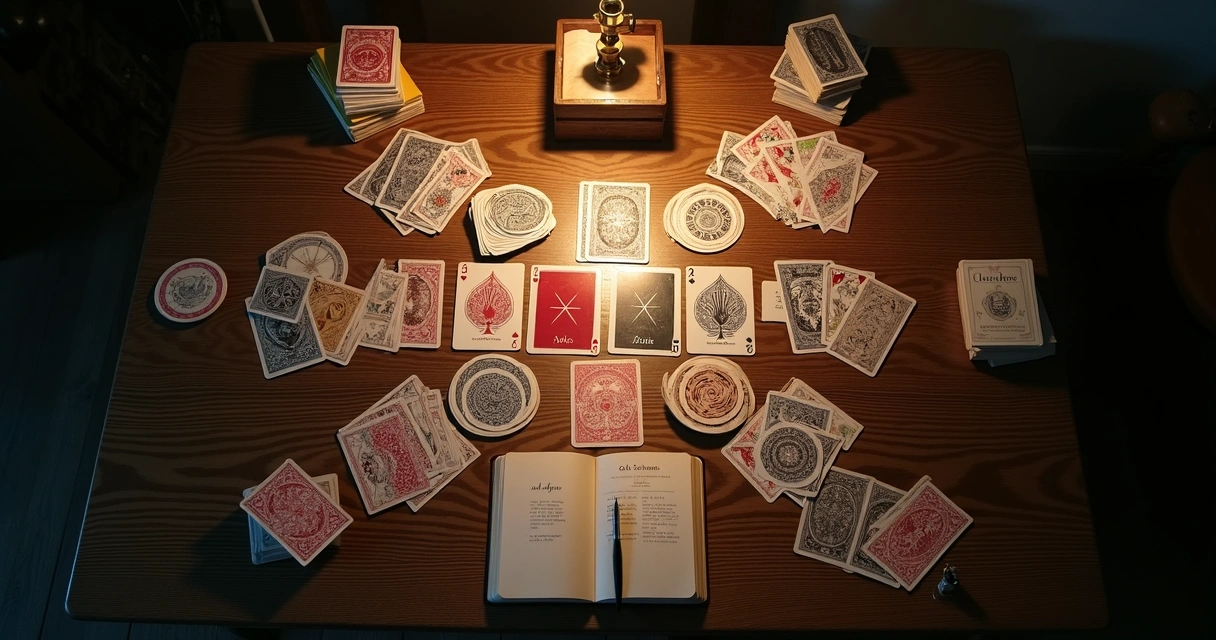
We often meet readers who feel a quiet pull toward using more than one deck in the same session. It usually starts in a simple way. One deck gives the structure, another adds tone, and a third brings timing or mood. Then the question comes: how do we combine them without turning the reading into clutter?
A good multi-deck spread is built on purpose, not on quantity.
In our experience, effective cartomancy spreads do not become stronger just because we place more cards on the table. They become stronger when each deck has a clear job. That is the point where a layered reading starts to feel clean, focused, and useful for both the reader and the querent.
For professionals who keep detailed records, this matters even more. When we document sessions in MysticLog, we can often see that the clearest multi-deck readings are the ones designed with strong boundaries from the start. Each layer of the spread answers a different part of the question. Each deck supports the others instead of competing with them.
Why readers use more than one deck
Single-deck readings can be direct and complete. Still, there are times when one deck does not cover the whole texture of the question. A querent may ask about love, but there is also family pressure, old grief, and a career move in the background. That is where multiple decks can help us separate threads.
We think of multi-deck work as a way to assign voices. One deck may speak in practical terms. Another may speak in symbols or emotion. Another may clarify hidden influences. This kind of structure reflects what many readers already feel in practice: cards are not just random tools, they are part of a physical and mental exchange shaped by style, handling, and setting, much like the cultural reading practices discussed in studies from the University of Missouri–St. Louis on tarot and cartomancy.
Each deck should have one voice.
That one sentence prevents many problems. If every deck says everything, the spread loses form.
Start with the question, not the decks
Many readers do the opposite. They pick beautiful decks first and then try to force a spread around them. We have done that too. It feels exciting for a moment, but the reading often becomes vague.
The question should decide the spread design.
Before choosing any cards, we should define what the reading needs to answer. Is the querent asking for:
- Clarity on a present situation
- Comparison between two options
- Emotional insight
- Hidden motives
- Likely next steps
Once we know that, we can assign roles. A practical way to build the spread is to divide the question into layers. For example, a relationship reading may need one deck for current energy, one for what is hidden, and one for advice. A business reading may need one deck for facts, one for risk, and one for timing.
If we skip this planning step, we may still get a reading, but not always a readable one.
Choose decks that do different jobs
Not all decks should be used in the same way. In cartomancy, each system has its own rhythm. A playing card deck may give direct, grounded answers. An oracle deck may soften the message and add emotional framing. A Lenormand-style layer may narrow the focus with blunt detail. The best pairings are not identical decks. They are decks with distinct strengths.
The best deck combinations create contrast without conflict.
We suggest asking three simple questions before combining decks:
- What does this deck do well?
- What does it struggle to express?
- How will the next deck fill that gap?
For example, if one deck is rich in mood but light on specifics, we can pair it with a deck that gives sharper event-based signals. If one deck tends to be blunt, we may pair it with a deck that helps us phrase the message with care.
This kind of thinking is also useful when building long-term client records. In MysticLog, readers can store deck choices, card layouts, and follow-up notes, which helps reveal which deck pairings consistently produce clear sessions for certain kinds of querents.
Give each deck a fixed position in the spread
Once we have chosen the decks, we need to define where each one goes. This is where many multi-deck spreads either become elegant or fall apart.
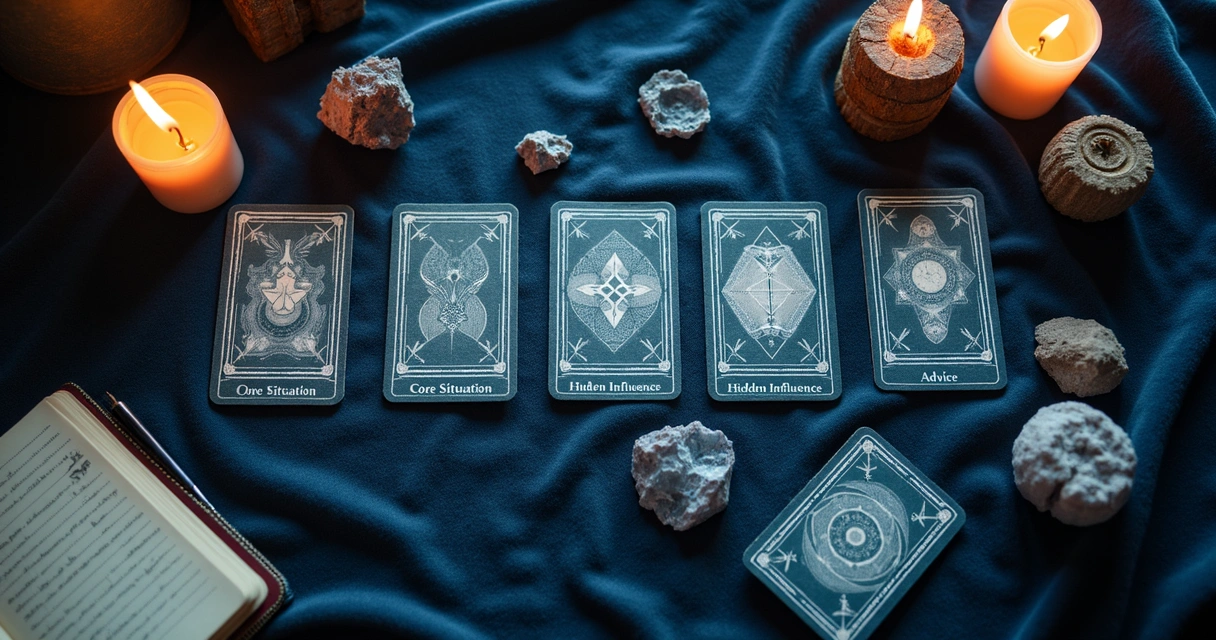
We prefer fixed roles such as:
- Deck one for the core situation
- Deck two for shadow or hidden influence
- Deck three for advice or next movement
Another option is to build by timeline:
- One deck for the past root
- One deck for the present condition
- One deck for the near future
What matters is consistency. When a deck always speaks for one area, interpretation becomes easier. We do not need to renegotiate meaning every time we turn a card.
Readers who already enjoy structured layouts may find inspiration in related spread formats such as simple to deeper spread patterns, major arcana focused layouts, and spiritual spread structures for meaningful readings. Even when we work in cartomancy rather than tarot, the logic of assigning positions still applies.
 Keep the spread small at first
It is tempting to go wide. We understand that feeling. Multi-deck work can feel rich and inspiring. But when too many cards appear too early, the message gets buried.
Start with fewer cards than you think you need.
A reliable beginner structure for multi-deck cartomancy is nine cards total:
- Three cards from deck one for the main issue
- Three cards from deck two for what supports or blocks it
- Three cards from deck three for guidance
This gives enough material for layered insight without overwhelming the querent. It also gives us room to pull a clarifier only when needed, not out of habit.
We have seen many readings improve just by removing excess cards. A spread should breathe. Silence between cards is part of the method too.
Build a reading sequence that flows
Good multi-deck spreads are not just layouts. They are reading paths. We need to know in what order we will interpret the parts.
We usually suggest a sequence like this:
- Read the foundation deck on its own.
- Read the second deck only in relation to the first.
- Read the third deck as response, advice, or outcome.
- Step back and state the full message in plain language.
This order keeps us from mixing signals too soon. If we start cross-referencing every card from every deck at once, the spread becomes hard to hold in the mind. A layered process is calmer. It also makes note-taking easier.
For readers who work with clients regularly, this sequence is very useful in written records. It creates cleaner summaries, stronger follow-up sessions, and better recall months later.
Watch for repetition and contradiction
When several decks are used together, patterns matter more than isolated meanings. We should pay attention to repeating suits, repeated emotional tones, recurring numbers, or the same theme appearing through different symbols.
Repetition across decks usually marks the real center of the reading.
If three decks point to delay, restraint, or guarded feelings, we should not ignore that because one card looks more hopeful. The spread is showing weight. On the other hand, contradiction is not always a problem. It may show conflict between desire and action, public life and private life, or fear and opportunity.
A few areas where contradiction can be useful are:
- What the querent says versus what they feel
- What is possible versus what is likely
- Short-term comfort versus long-term growth
Those moments often produce the most honest part of the session.
Record what worked after each reading
This is the habit that turns experimentation into skill. After each multi-deck spread, we should write down what decks were used, what positions they held, what patterns came up, and how the reading felt in practice.
We do not need pages of notes every time. A short record is enough if it is clear.
For instance, we may note that one oracle deck works well only in the final advice position, or that one playing card deck gives sharp answers for career readings but feels too dry for grief work. Over time, these observations shape a personal reading system.
That is one reason a platform like MysticLog fits so naturally into a professional cartomancy practice. When spread structure, card images, querent history, and follow-up reflections live in one place, we can see long-term patterns that paper notes often hide.
 Avoid the most common mistakes
We have seen the same issues come up again and again. They are easy to fix once we name them.
Here are some of the most common problems in multi-deck cartomancy:
- Using decks with no assigned role
- Pulling too many clarification cards
- Mixing systems without understanding their reading style
- Asking a broad question and expecting a narrow answer
- Focusing on card meanings but ignoring card position
The fix is usually simple. Reduce the size of the spread. Sharpen the question. Reassign the decks. Then read again with steadier boundaries.
If you also work with themed readings, spread planning can become even stronger when matched to topic. We have seen this in love and spiritual sessions, but also in practical consultations such as career spread approaches and seasonal work like full moon spread planning for release and intention. The same idea holds true in cartomancy: a spread works better when its frame matches the question.
Conclusion
Creating effective multi-deck spreads in cartomancy is less about collecting more tools and more about giving each tool a clean task. When we begin with the question, choose decks with different strengths, assign fixed positions, and keep good records, the reading becomes easier to trust and easier to revisit.
We have found that the best multi-deck sessions feel clear, not crowded. They leave the querent with a message they can follow, and they leave the reader with a structure they can refine over time. If you want a better way to track your deck pairings, reading notes, and repeat client history, we invite you to get to know MysticLog and see how it can support your cartomancy practice with more order and continuity.
Frequently asked questions
What is a multi-deck spread?
A multi-deck spread is a card reading layout that uses two or more decks in one session. Each deck usually has a separate role, such as showing the main issue, hidden factors, timing, or guidance. It works best when each deck answers a different part of the question.
How to choose decks for a spread?
We suggest choosing decks by function, not only by artwork. Start by asking what the reading needs. Then pick one deck for structure, another for detail, and another for tone or advice if needed. Try combining decks that speak in different ways so they support each other instead of repeating the same message.
What are the best decks to combine?
The best combinations depend on your reading style, but in general, pair decks that offer contrast. A direct cartomancy deck can work well with a softer oracle deck, or a symbolic deck can pair well with one that gives practical signals. The best match is the one that brings clarity without adding noise.
How can I interpret mixed deck readings?
Read one layer at a time. Begin with the base deck and understand its message first. Then bring in the second deck as support, challenge, or context. Finish with the final deck for advice or likely movement. Watch for repeated themes, suit patterns, and contrasting signals. Those links often reveal the strongest meaning in the spread.
Is it worth it to use multiple decks?
Yes, if the extra decks serve a clear purpose. Multi-deck readings can give more texture, better separation of themes, and stronger follow-up insights. They are most useful for readers who want layered sessions and who keep good notes on what works. In our experience, they become even more valuable when tracked over time in a system like MysticLog.