

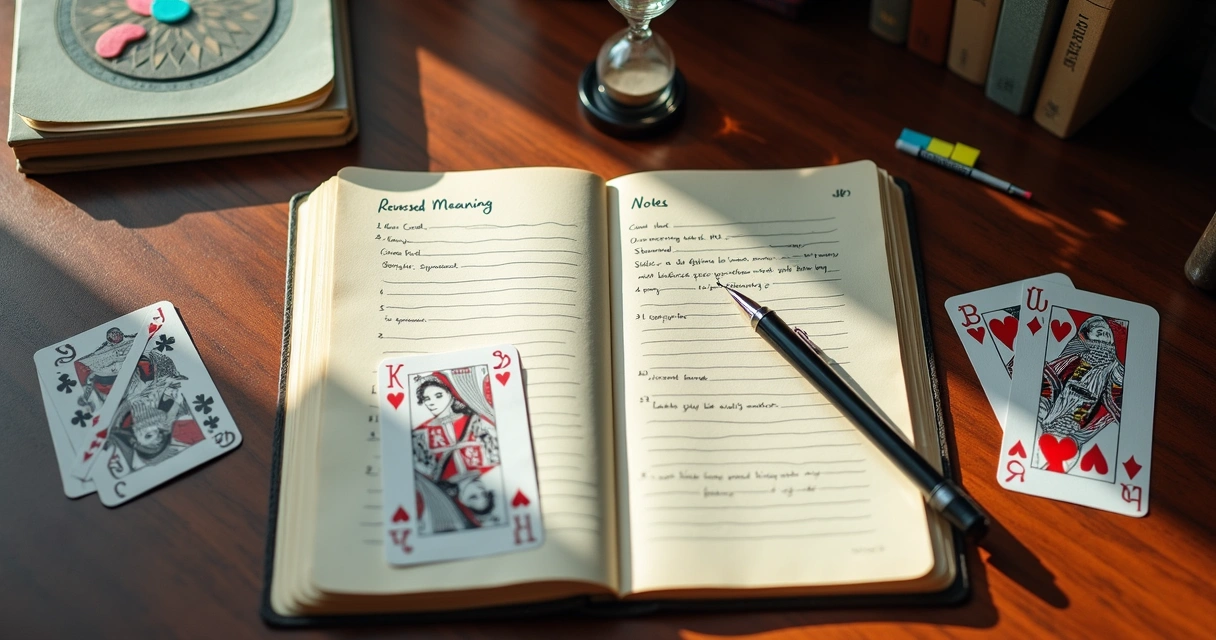
We have seen this happen many times. A reader gives a sharp, honest cartomancy session, notes the upright cards well, then rushes through the reversed ones with vague words like “blocked” or “delay.” A month later, the querent returns, asks about the same relationship or work issue, and the earlier notes do not say enough. The thread is lost.
Accurate documentation of reversed playing card meanings starts with consistency, not with guessing.
When we work with playing cards in spiritual practice, reversals can hold weight. They may show resistance, inner tension, hidden motives, delayed movement, weakened force, or a meaning that turns inward. But none of that helps us if our records are thin. Good records let us see patterns across months and years. They also help us protect the nuance of our own reading style.
This is one reason platforms like MysticLog matter in a growing practice. When we keep client histories, card positions, images, and interpretation notes together, reversed cards stop being scattered fragments and become part of a readable story.
Why reversed meanings are hard to record
Reversed playing cards can be harder to document than upright ones because they often do not have one fixed meaning. In our experience, many readers use reversals in one of several ways. They may treat them as the opposite of the upright meaning, a reduced version of it, an internal version, or a warning around timing and flow.
A reversed card is not only a card upside down. It is a card in context.
That context includes the question, nearby cards, the suit, the number or court rank, and the client’s known history. A reversed 10 of Hearts in a family reading may point to emotional strain at home. In a business reading, it may point to image management, social pressure, or a public smile covering private stress.
Context gives the reversal its voice.
History also matters. Research on the long cultural history of playing and tarot cards shows how deeply cards have moved through symbolic, literary, and visual traditions. That long history helps explain why one simple card can carry layers of meaning. We are not working with flat symbols. We are working with symbols shaped by memory, culture, and reading method.
Set your reversal method before you log anything
The first step is simple, though many readers skip it. We need to decide what a reversal means in our own system before we begin recording it for clients. If we change our method every week, our notes become unstable.
We suggest choosing one core interpretation model and sticking to it unless a clear reason appears in the spread.
Common reversal models include:
- Opposition to the upright meaning
- Blocked or slowed expression of the card
- Private, hidden, or internalized energy
- Excess, distortion, or imbalance of the card’s force
Once we choose a model, we should write it down in our reading framework. That way, when we later review a session, we know what “reversed 8 of Clubs” meant in our practice at that time.
If we teach students or work with repeated clients, this also creates a stable language. That stability builds trust.
Build a note structure that captures meaning clearly
We have found that vague note-taking causes most reversal errors. To avoid that, we can use a repeatable format for each reversed card. The format does not need to be long. It just needs to catch the right details.
The best records separate the card itself from the interpretation you gave in that exact session.
A clean structure may include:
- Card name and orientation
- Spread position or question area
- Base upright meaning in your system
- Reversal modifier you applied
- Session-specific interpretation
- Client reaction or confirming detail
For example, instead of writing “9 of Spades reversed, anxiety,” we can write something far more useful:
9 of Spades reversed in outcome position: worry is hidden, not gone. Client presents calm but admitted sleep issues and fear about legal delay.
Now the note is alive. It tells us what we saw, why we said it, and how the client confirmed it.
If we want to sharpen note habits in general, our article on how to keep accurate notes for complex spreads supports this same discipline across larger layouts.
 Use suit, rank, and pattern instead of isolated keywords
One of the easiest ways to document reversed cards better is to stop treating them as single keywords. Playing card systems usually carry meaning through suit and rank patterns. When we note those patterns, our records become more accurate and easier to review.
For instance, if our system links Hearts to emotion and relationships, Spades to challenge or thought, Diamonds to material exchange, and Clubs to action or growth, the reversal can modify that suit language in a readable way.
We may ask:
- Is the suit energy blocked, hidden, weakened, or overdone?
- Does the rank show a stage, person, or level of pressure?
- Do nearby cards confirm tension, delay, or private conflict?
Studies on how people perceive and remember common cards, including work on visibility and memorability in common playing cards, suggest that some cards stand out more strongly than others in human memory. That matters for documentation. Cards that are more visually or emotionally marked may shape our recall more than quieter number cards. Written notes protect us from memory bias.
We think this is especially helpful with repeated cards across sessions. If the same reversed suit keeps appearing for a querent, that pattern may matter more than any one card in isolation.
Document what you observed, not only what you concluded
This part changes everything. Many readers write only the final message they gave. We should also record the signs that led us there.
When we document the path of interpretation, we make future review far more reliable.
That means noting things like:
- The card cluster around the reversal
- The spread position and timing layer
- Whether the client reacted at once or needed time
- Whether the reversal felt psychological, practical, relational, or spiritual
In divination work, perception matters. A study on tasseography and experienced divinatory interpretation highlights how trained readers derive meaning through pattern recognition, ritual focus, and interpretation shaped by practice. Playing card reading often works the same way. We do not just decode symbols. We observe, connect, and interpret. Good notes should reflect that process.
Sometimes a small note saves a whole future reading. We may write, “Client laughed when reversed Queen of Diamonds appeared, then admitted money stress tied to mother.” Months later, that line can explain a much larger cycle.
Create a separate field for standard meanings
In our experience, one of the cleanest ways to avoid confusion is to separate personal card definitions from session notes. This is where a dedicated system helps. In MysticLog, readers can keep detailed histories and return to earlier consultations without flipping through mixed pages where theory and client detail blur together.
We suggest keeping two levels of meaning:
- A standard card meaning entry for your own system
- A session entry for how that reversal showed up in this reading
That split keeps your method stable while still honoring the individuality of each querent. It also helps when your own understanding grows over time. You can refine the standard meaning without rewriting a past session.
Readers who want stronger journaling habits may also like our piece on a guide to Tarot journaling for insightful readings. Even if you mainly read playing cards, the note structure carries over well.
Avoid the most common documentation mistakes
Some errors show up again and again. We have made a few of them ourselves in earlier years, so we say this with sympathy.
The most common mistakes include:
- Using the same reversal keyword for every card
- Failing to note the spread position
- Mixing upright and reversed definitions in one sentence
- Writing only abstract terms with no real-life reference
- Skipping the client’s confirming response
- Changing reversal rules without recording the shift
These issues are close to the broader note-taking problems we discussed in our article about common mistakes when recording oracle readings. The tools differ by system, but the note discipline is much the same.
We also think it helps to avoid overpromising certainty. If a reversed card felt ambiguous, we should write that. A note such as “possible internal conflict, not yet confirmed” is honest and still useful.
 Make reversals easier to review over time
Documentation is not only for the day of the reading. It is for future pattern review. That is where many professional readers gain depth.
Reversed cards become more meaningful when we can track them across repeated sessions.
If a querent receives reversed Hearts across three relationship readings, we may be seeing a long emotional pattern rather than a one-time issue. If court cards reverse around career readings, we may be looking at unclear roles, mixed motives, or self-presentation strain.
To support long-term review, we can tag entries by:
- Suit
- Card rank
- Life area
- Timing issue
- Confirmed outcome
This is also where spread design matters. If you want to compare how reversals behave in different layouts, our resources on spread structures from simple layouts to deeper insights can help shape cleaner records, and our page on card meanings and symbolic interpretation can support the habit of building clear reference language.
Conclusion
Accurate reversal notes do not require long essays. They require a stable method, clear structure, and honest observation. When we record the card orientation, the position, the reversal model, the specific reading context, and the querent’s response, we create notes that still speak months later.
That is the real goal. We want to return to a past session and still hear what the cards were saying.
If you are ready to keep your reversed playing card meanings in a more organized and professional way, we invite you to get to know MysticLog and see how it can support your client records, reading history, and long-term spiritual practice.
Frequently asked questions
What is a reversed playing card meaning?
A reversed playing card meaning is the interpretation given when a card appears upside down and is read as modified energy.
In most systems, the reversal does not create a random new meaning. It changes the upright one. Readers may treat it as blocked energy, delay, inner conflict, hidden motives, reduced force, or excess. The exact meaning depends on the reading method and the surrounding cards.
How to record reversed card meanings correctly?
Record reversed card meanings by noting the card, its orientation, spread position, your reversal method, and the session-specific message.
We suggest writing the base card meaning first, then the modifier you applied because it was reversed, and then the final interpretation for that querent. Add any client confirmation if it appeared. This creates notes that make sense later and not just in the moment.
Why document reversed meanings separately?
Documenting reversed meanings separately helps us keep our system clear and avoid mixing theory with client-specific interpretation.
When upright and reversed meanings are stored as separate references, we can review readings faster and spot repeating patterns more easily. It also helps if our personal card system grows over time, because we can update standard meanings without changing old session notes.
Where to find reliable reversed meanings?
Reliable reversed meanings come from a consistent reading system, tested session notes, and careful comparison across real readings.
We recommend building a personal reference based on your chosen cartomancy method and refining it through documented client work. Reliable meaning is not only about a fixed list. It is also about whether the interpretation proves useful, repeatable, and true to your practice over time.
What are the best tips for accuracy?
The best tips for accuracy are to use one reversal model, write in a fixed format, and track patterns across sessions.
We also suggest noting the spread position, nearby cards, life area, and client reaction. Avoid one-word notes unless they are supported by more detail. If you keep records in one place, as many readers do with MysticLog, it becomes much easier to review reversals and keep your interpretations steady.