

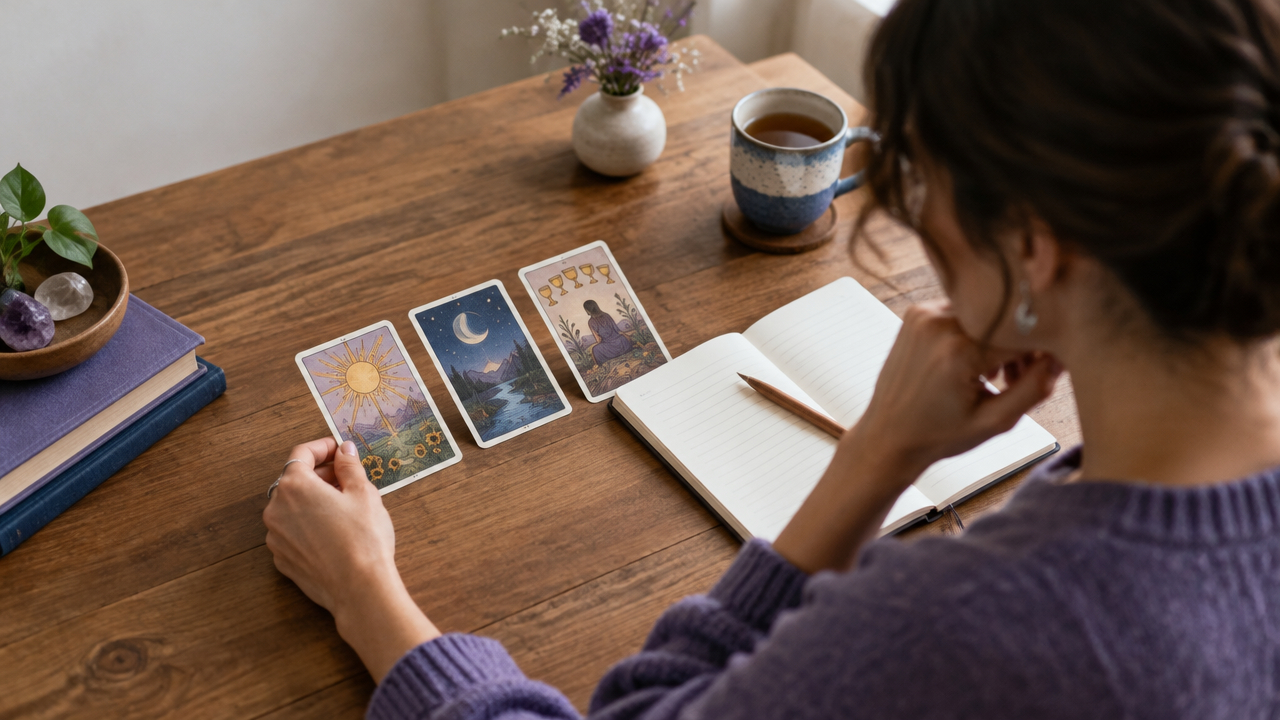
A personal tarot reading is clearer when you treat it as a structured reflection, not a test you must pass or a prediction you must believe. A focused question, a small spread, and a written record can help you separate what the cards show from what you hope or fear they mean. Use the process below to make your reading more thoughtful and practical.
Key takeaways for a clearer self-reading
- Choose one open-ended question about your own choices, feelings, or next steps.
- Use one card for a quick check-in or three cards to explore a situation from different angles.
- Notice your first response before looking up traditional meanings.
- Write down the interpretation and one grounded action, then avoid pulling again just to get reassurance.
- Use tarot as a reflective tool, not as proof about another person or a substitute for professional advice.
Start with a question you can actually explore
A useful tarot question points toward reflection or action rather than demanding certainty about the future. Ask about your perspective, options, or a situation you can influence. For example, “What would help me approach this conversation with more care?” gives you more to work with than “Will they call me?”
Before shuffling, write down the question and the context in one sentence. If the issue involves someone else, keep the focus on your experience and choices instead of trying to establish what they secretly think or feel.
- Try: “What am I overlooking in this decision?”
- Try: “What boundary would support me here?”
- Avoid: “Will everything work out exactly as I want?”
- Avoid: asking the same question repeatedly until a card feels reassuring.
For a love reading, focus on communication, needs, or your own next step. A two-card spread can compare your perspective with the action you want to take without claiming to reveal another person’s private thoughts.
Choose a spread small enough to interpret well
One or three cards are usually enough for a personal reading. More cards create more details to connect, which can make it harder to tell the central message from an interpretation built around a preferred answer.
| Spread | Useful for | Positions to try |
|---|---|---|
| One card | A brief check-in or daily reflection | What deserves my attention? |
| Three cards | Exploring a situation with context | What is happening, what can I consider, what is one next step? |
| Three cards | Working through a decision | Option A, option B, what value should guide me? |
Choose position meanings before you draw. “Past, present, future” is familiar, but it can encourage you to read the cards as fixed predictions. Positions about perspective, choices, and actions keep the reading open to your judgment.
Notice your first response before checking a guidebook
Look at the image before reaching for a card definition. Note the details you notice first, the mood of the scene, and what seems to connect with your question. Then compare those observations with the card’s established meanings and the position it occupies.
A helpful interpretation brings these pieces together rather than relying on only one. For example, if the Eight of Pentacles appears in a position about a next step, its themes of practice and attention might prompt you to build a skill steadily. That is a possible reading, not a guaranteed outcome or command.
- Describe what is visibly happening in the card.
- Write your immediate association without judging it.
- Check a trusted guidebook for traditional meanings.
- Connect the card to its position and your exact question.
- State the interpretation in one sentence, using “might” or “could” where appropriate.
This habit also strengthens your broader ability to understand a tarot reading: interpretation comes from the question, the card, its position, and the context together, not from a keyword in isolation.
Keep a record to separate insight from hindsight
A short journal entry makes it easier to revisit what you thought at the time, instead of reshaping the reading later to match what happened. Record the date, question, spread positions, cards, first impressions, and one practical next step. Revisit the note after a set period, such as a week, and compare your original interpretation with your experience.
That record can also show which questions lead to useful reflection and which ones tend to send you searching for certainty. For readers who work with clients, a consistent note-taking habit becomes even more valuable: MysticLog offers a centralized workspace for organizing client histories and session notes, while leaving interpretation in the reader’s hands.

How can you avoid reading only what you want to see?
Pause when a card seems to confirm exactly what you already believe. The American Psychological Association defines confirmation bias in psychology as favoring evidence that supports existing expectations while overlooking evidence that challenges them. In a self-reading, that can look like searching several interpretations until one validates the answer you wanted.
To make room for other possibilities, ask: “What is another reasonable way to read this card?” and “What detail in the image does not fit my first interpretation?” You do not have to force a negative meaning. The goal is to notice your assumptions, not to replace optimism with pessimism.
If you feel distressed, fixated, or unable to accept an uncertain answer, stop the reading. Repeated draws can add more material to interpret without resolving the underlying concern. Take a break, return to the question later, or talk with someone you trust.
Turn the reading into one grounded next step
A useful reading ends with something you can choose, observe, or do, rather than a prediction you have to wait for. Translate the interpretation into a small action, such as preparing for a conversation, setting a boundary, or gathering more information before deciding.
- Keep it within your control: choose an action that depends on your own judgment.
- Make it specific: decide what you will do and when you will do it.
- Leave room to revise: treat the interpretation as a prompt, not a verdict.
Tarot can support reflection, but it cannot guarantee accuracy or establish facts about the future. For medical, legal, financial, or safety decisions, use qualified professional guidance rather than cards alone. If you are learning, practice with simple spreads and compare your notes over time; confidence grows from thoughtful interpretation, not from forcing certainty.