

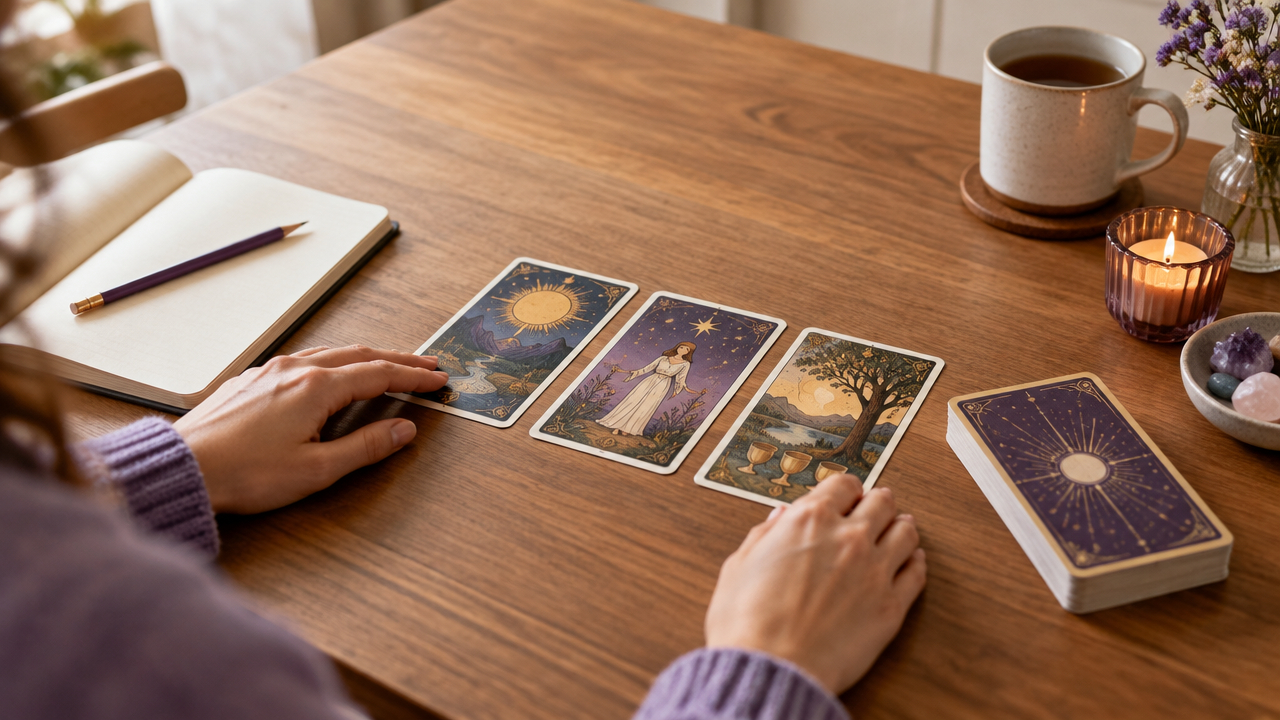
You can begin reading Tarot with one card, a clear question, and a few minutes of honest observation. This beginner-friendly method combines traditional meanings with your own response to the imagery, so you can practice without needing to memorize an entire deck first.
Confidence grows through a repeatable process, not perfect predictions. Start small, write down what you notice, and treat each reading as an invitation to reflect rather than a fixed verdict.
Start with these principles for a confident first reading
- Choose a deck whose images you can study comfortably.
- Ask an open question that gives you room to think.
- Describe the card before looking up its meaning.
- Use a simple spread and connect the cards to each other.
- Keep notes so you can learn from readings over time.
Choose a deck you can read consistently
Pick a deck with clear, engaging illustrations rather than searching for a universally perfect beginner deck. Many readers start with a 78-card deck based on the Rider-Waite-Smith tradition because its scenes offer visual details to interpret. If another deck feels more approachable to you, use it and consult its guidebook for deck-specific symbolism.
Most familiar Tarot decks have 22 Major Arcana cards and 56 Minor Arcana cards. The Minor Arcana is divided into four suits, often called Wands, Cups, Swords, and Pentacles or Coins. You do not need to learn every card before starting. Understanding the broad structure simply gives you helpful context as you practice.
Tarot has been used in different ways over time. The Metropolitan Museum’s tarot history describes early Tarot as a card game and notes that fortune-telling associations gained currency later. That context can help beginners approach the cards as a symbolic system, not as a test with one correct answer.
Ask a question that opens a useful conversation
A good Tarot question focuses on perspective, choices, or a next step. Instead of asking for a guaranteed outcome, ask what you can understand or influence in the situation. This gives the reading something practical to explore.
- Instead of “Will I get the job?”, ask “What can help me prepare for this opportunity?”
- Instead of “Does this person love me?”, ask “What should I consider about this relationship?”
- Instead of “When will everything change?”, ask “What is one helpful step I can take now?”
Before shuffling, take a moment to settle and repeat your question in plain language. For a personal reading, notice whether you feel strongly attached to one answer. If you do, write down that expectation; it may help you separate what the card shows from what you hope or fear.
Read one card by observing before consulting a guidebook
Begin with what is visible, then connect those observations to a traditional meaning and your question. This order helps you build interpretation skills instead of relying on keywords alone.
- Describe: Notice the figures, objects, colors, movement, and setting.
- Respond: Write down what draws your attention and what mood the image creates.
- Connect: Check the guidebook, then relate its meaning to your question.
For example, if a card shows someone carrying a heavy bundle, you might first notice effort, responsibility, or a difficult journey. The guidebook can offer traditional associations, but your final interpretation should explain how those ideas relate to the question at hand. A good reading makes that connection clear.

Use a three-card spread to connect meanings
A three-card spread gives you enough structure to explore a situation without making the reading complicated. Assign each position a distinct role, such as “what is happening,” “what needs attention,” and “a helpful next step.” These positions encourage reflection without presenting the future as settled.
Suppose you are unsure how to approach a challenging conversation. The first card might suggest what is shaping the situation, the second what you are overlooking, and the third an approach worth considering. Read the cards as parts of one story, not as three unrelated definitions.
For a relationship question, a two-card spread can also help you compare your perspective with a possible point of tension. Keep the positions neutral and avoid using the cards to claim certainty about another person’s private thoughts. The goal is to clarify your choices and boundaries.
Can you teach yourself Tarot with a daily card?
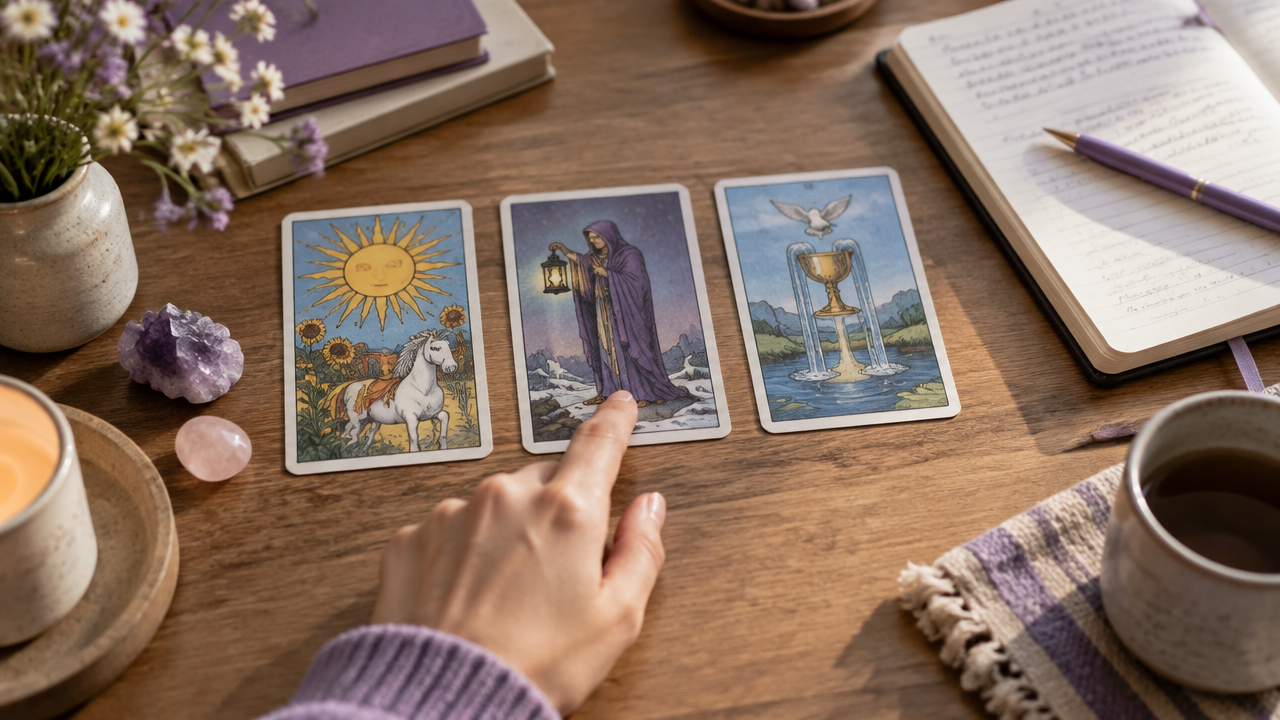
Yes. A short daily draw is a practical way to learn the cards, especially when you record your first impressions before checking a reference. Consistency matters more than the number of cards you study in one sitting.
Use a simple journal entry with the date, your question or focus, the card, your observations, and the guidebook meaning you found. Later, add a note about what still feels relevant. This creates a personal record of how your interpretations develop, rather than leaving practice as a series of disconnected impressions.
When reading for yourself, avoid drawing extra cards repeatedly just because the first answer feels uncomfortable or unclear. Take a break, return to your notes, and consider whether a more focused question would help. If you want to explore a card’s meaning further, compare your observation, the traditional interpretation, and the context of the spread.
Keep beginner readings grounded and respectful
Clear boundaries make Tarot practice more thoughtful. Cards can prompt reflection, but they cannot replace someone’s consent, professional advice, or direct communication.
- Explain your question and spread positions before you begin a reading for someone else.
- Use language such as “this may invite you to consider” rather than promising a certain outcome.
- Do not present a card as a diagnosis or as a substitute for medical, legal, or financial guidance.
- Respect privacy, and ask permission before recording or sharing someone’s reading.
- Pause if you feel too distressed or distracted to interpret the cards carefully.
These habits are useful whether you read for yourself, practice with a friend, or eventually offer consultations. As you improve, look for explanations that show how the imagery, card meaning, question, and spread position work together. That is more useful than memorizing a single keyword for every card.
Let a steady practice support future growth
Understanding how a Tarot reading moves from question to interpretation can become the foundation for a sustainable professional practice. If you later read for returning clients, organized notes can help you remember the question, spread, and themes discussed in earlier sessions without relying on scattered notebooks.
MysticLog is a client management platform for Tarot and other spiritual professionals. It gives readers a centralized place to keep client histories, reading notes, and spread records; its AI Mystical Assistant can offer additional perspectives while leaving the final interpretation to the reader. For now, build confidence one thoughtful reading at a time, and let your record of practice show you how your skills grow.