


A Lenormand reading journal helps professional readers preserve the details that make a consultation useful later: the question, spread, card order, combinations, interpretation, and follow-up. MysticLog brings those notes, spread images, and client histories together, while Mysty can summarize documented consultation history to help you prepare for a returning client. The aim is not to automate your reading, but to make your own observations easier to retrieve and review.
Key takeaways for a practical Lenormand journal
- Record the exact question, spread structure, and card order before writing your interpretation.
- Capture combinations in context instead of relying on a list of fixed meanings.
- Separate what you observed, what you interpreted, and what you learned later.
- Keep client notes and spread images attached to the right consultation.
- Use Mysty to recall documented details, then verify the summary and make your own decisions.
A useful reading log makes consultations retrievable
A journal is most valuable when you can find the right entry and understand it months later. A record that says only “Clover, Fox, Letter” may preserve the cards, but not the question, sequence, or reasoning that shaped the reading.
For each session, capture enough context to distinguish this reading from another: the date, client or private reference ID, question, deck or method if relevant, and the spread used. Then write the cards in their actual positions and note your interpretation in plain language.
This structure also creates a useful distinction between session notes and a personal card reference. Your reference pages can hold your evolving keywords, while the consultation log shows how you applied those ideas in a specific situation. If you are refining your card foundations, a practical Lenormand meanings and spreads guide can sit alongside your own working notes.
What should you record after a Lenormand consultation?
A consistent template makes sessions easier to document without turning note-taking into a second reading. Keep the same core fields each time, then add details only when they matter to the question or spread.
- Session context: date, client identifier, question, and the focus agreed with the querent.
- Method: spread name or layout, card deck if needed, and any position meanings you assigned.
- Card record: card names in order, positions, nearby cards, and the overall structure.
- Interpretation: main message, significant combinations, alternative possibilities, and what you explained to the client.
- Follow-up: any agreed action, open question, or check-in the client requested.
Keep the language concise and factual. Mark a client’s own words as their account, and distinguish them from your interpretation. This makes later review clearer and reduces the risk of remembering your earlier impression as something the client said.
Record combinations in context, not as isolated keywords
Lenormand interpretation often depends on how cards relate to one another, so preserve both the sequence and your reasoning. A combination note should explain what the cards suggested in that question, rather than presenting one pairing as a rule that applies every time.
For example, if Fox and Letter appear together in a question about a work email, record the question, their positions, the surrounding cards, and why you considered caution or careful checking relevant. Note another plausible reading if you offered one. That gives your future self a fair record of the choices available at the time.
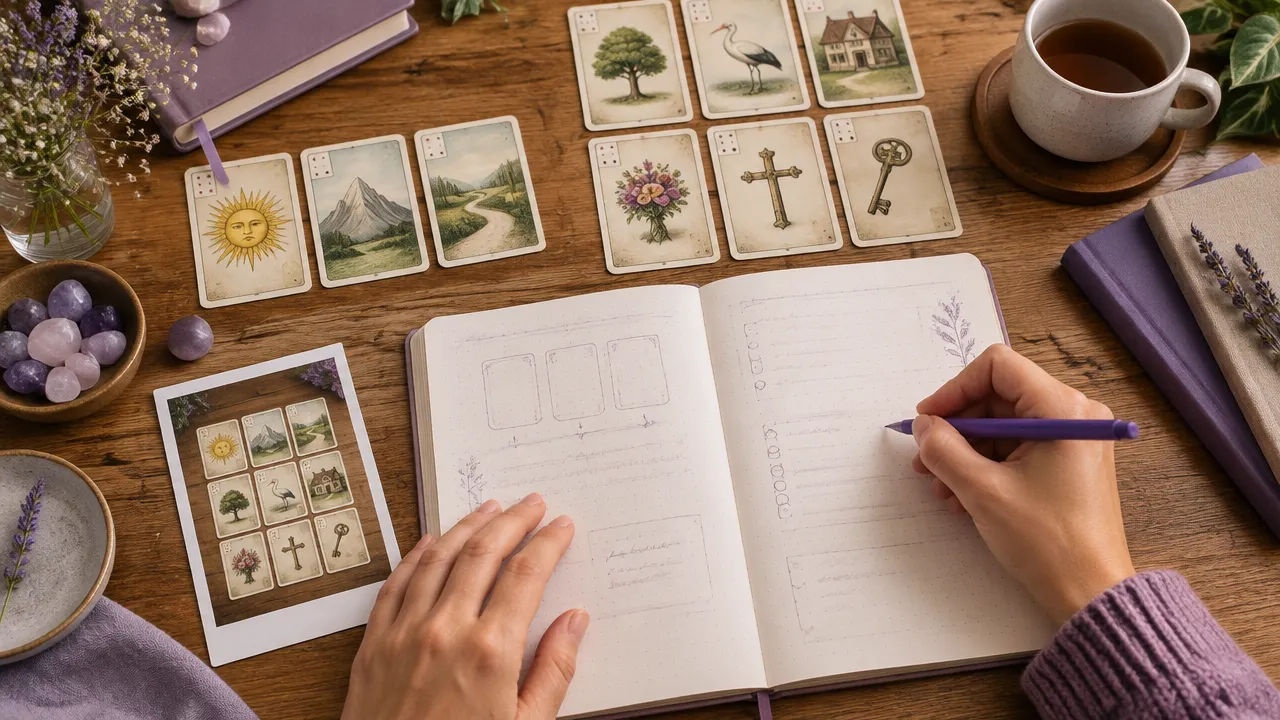
For larger layouts, write down the reading path you used: which cards you treated as central, what lines or neighboring cards informed your interpretation, and how you connected separate clusters. Use a quick sketch or photo when a written sequence cannot capture the layout accurately. A repeatable approach to documenting complex spreads can help you build a clear record even when a reading involves many positions.
Attach spread images when layout carries meaning
A photograph can preserve spacing, direction, and groupings that are easy to lose in a text-only note. It is especially useful when you want to revisit a larger tableau, compare a client’s later question with an earlier layout, or remember which cards you read together.
Take the image after the spread is complete, and attach it to the matching consultation rather than storing it in a general camera folder. Add a short caption that names the spread and explains any markings or reading path. The image should support your notes, not replace them: write the question and interpretation in searchable text.
Before saving a client image or sensitive session details, use a consistent privacy practice. Keep only what serves the professional relationship, restrict access to client records, and follow the privacy obligations that apply to your work and location. For a broader workflow, see these approaches to organizing consultation records.
Review past readings without forcing a right-or-wrong score
Review is most useful when it examines your process, not when it reduces nuanced consultations to a simple prediction score. A client’s later circumstances may be incomplete, changed, or remembered differently, so preserve what was known during the original session and what was shared afterward as separate notes.
At a suitable interval, revisit a few entries and ask:
- Which combinations or layout features guided my interpretation?
- Did I distinguish clearly between observation, possibility, and advice?
- What new context did the client later provide, and how did it change the picture?
- Do I notice a recurring interpretive habit I want to examine?
This kind of review helps you refine your own reading style while respecting uncertainty. It can also make follow-up more personal, because you can recall what the client actually discussed instead of relying on a vague impression.
MysticLog connects the journal to client history
A paper journal can be personal and flexible; a digital client-management workspace can make records easier to search and connect across sessions. MysticLog lets Lenormand professionals maintain client profiles, consultation notes, and images in a centralized history, so a spread does not have to live apart from the relationship it belongs to.
| Journal need | What to keep | How it helps |
|---|---|---|
| Session recall | Question, date, cards, and interpretation | Reconstructs the reading later |
| Visual detail | Photo or sketch of the spread | Preserves layout and groupings |
| Client continuity | Notes attached to a client profile | Connects consultations over time |
| Practice operations | Appointments and follow-up reminders | Keeps administration near the client record |
You remain responsible for deciding what belongs in a client record and how to interpret it. MysticLog also includes an online booking link, calendar, and email and WhatsApp reminders, helping readers keep scheduling and consultation history in one workspace. A consistent approach to separating returning client histories is important whether your notes are in a notebook, spreadsheet, or dedicated platform.
Mysty can summarize history, but your notes remain the source
Mysty is MysticLog’s AI-powered assistant. It can summarize a client’s previous readings and consultations to help you recall documented details, recurring themes, and observations before the next appointment. That can make preparation faster when you have several returning clients and years of notes to navigate.
Use the summary as a prompt for review, not as an authority. Open the original entries to confirm details, correct anything unclear, and decide what is relevant to today’s question. The quality of any summary depends on the notes available, and an AI assistant cannot replace your professional judgment or the client’s current account.
A careful workflow is simple: review the summary, verify key points in the session history, then ask the client what has changed. This preserves continuity without treating an earlier reading as a fixed script. For more on combining client records with AI support, explore AI tools for cartomancy workflows.
A repeatable workflow keeps journaling manageable
Documentation does not need to be lengthy to be useful. A brief routine after each session can preserve the details that matter while keeping your attention on the client during the reading.
- Save the date, question, and agreed focus.
- Write the spread layout and card order before summarizing meaning.
- Record the main combinations and the reasoning behind them.
- Attach a spread image when the layout adds important context.
- Add follow-up notes only when new information or an agreed check-in occurs.
- Before a returning session, review the record and confirm what remains relevant with the client.
With MysticLog, this process can sit within the same client timeline you use for appointments and reminders. Whether you start with a notebook or move to a digital workspace, the most useful Lenormand journal is the one you can maintain, search, and interpret responsibly.
Frequently asked questions
What should I write in a Lenormand reading journal?
A useful Lenormand journal records the client’s question, date, spread layout, card order, key combinations, interpretation, and any agreed follow-up. Add a brief note about what was known at the time and, when appropriate, a later outcome. This makes past readings easier to review without relying on memory alone.
How do you record Lenormand card combinations?
Record combinations in their original order and note how you read them in that specific question. For example, write the two cards, the shared idea you considered, and how the surrounding cards changed the meaning. Keeping observation separate from interpretation helps you revisit your reasoning without treating one meaning as universal.
Can I keep a Lenormand reading journal digitally?
Yes. A digital journal can make client histories, spread images, and follow-up notes easier to search and keep together. Choose a system with clear client profiles and organized session records, and handle personal information carefully. A notebook can still work well if you have a consistent way to index and protect it.
How can I review old Lenormand readings?
Review past readings by comparing your original notes with later information, while keeping the client’s own account distinct from your interpretation. Look for patterns in how you read combinations, where context changed your view, and what remains uncertain. This supports reflective practice without turning every reading into a simplistic right-or-wrong score.
How can Mysty help with Lenormand consultation notes?
Mysty can summarize a client’s previous consultations to help you recall documented themes and details before a new session. Treat the summary as a starting point, check it against the original notes, and make your own interpretive decisions. AI support should assist your workflow, not replace your professional judgment or client consent.